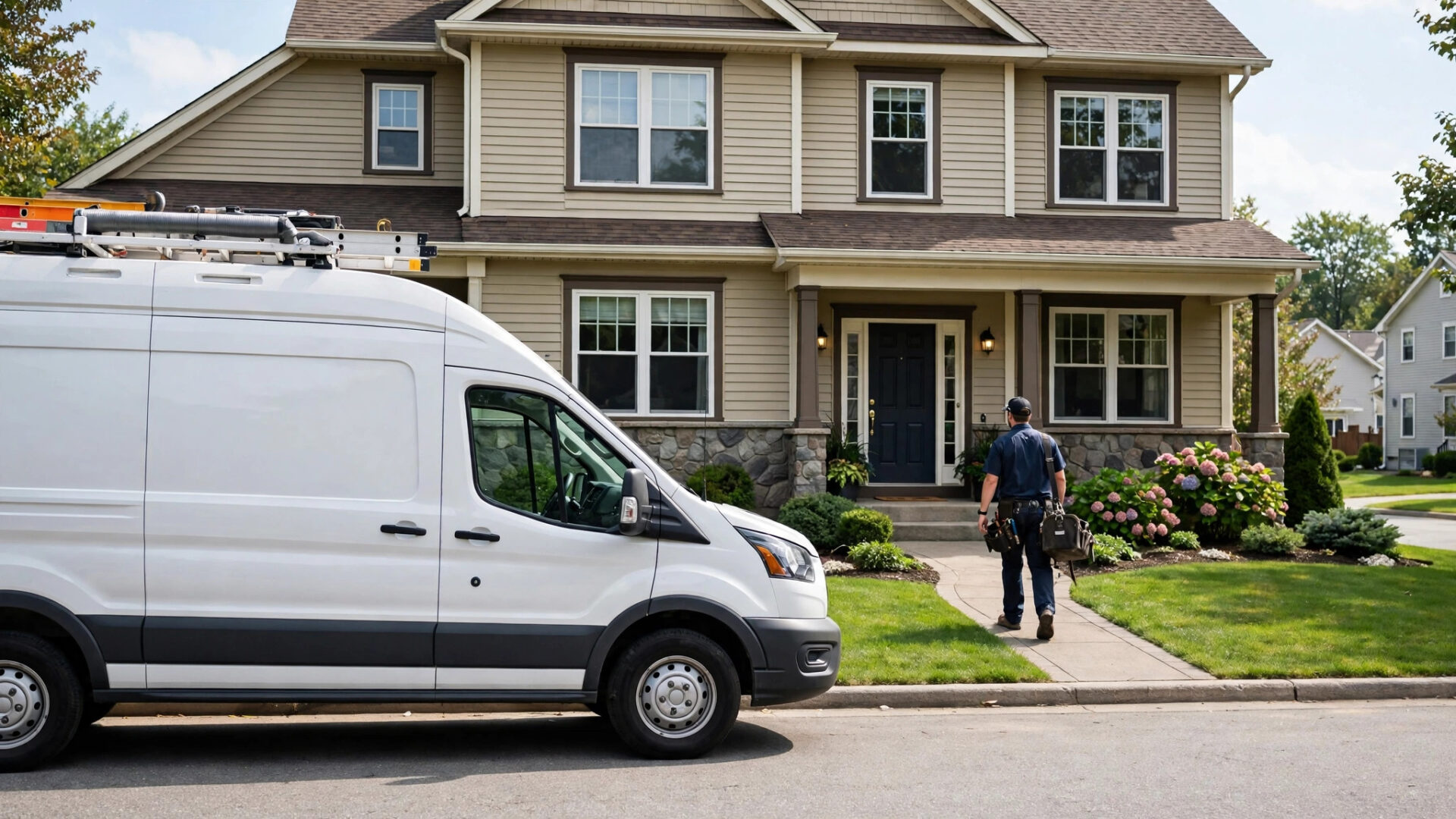
The AC dies on the hottest day of the year. The homeowner searches “AC repair near me”, sees your company with 22 reviews next to a competitor with 400, and calls the competitor. Your techs might be better and your prices fairer, but the decision happened on the review count. This guide shows how to get more Google reviews for your HVAC company: how technicians can ask at the job site, which messages to send, and how to keep reviews coming in every season.
This guide builds a review generation system made for HVAC: technician-driven requests at the job site, SMS and email templates for repairs, installs, and tune-ups, a service recovery process that catches unhappy customers before they review, and the link between reviews and map pack rankings. Run it consistently and the reviews compound.
The quick answer
- Who asks: your technician, at the job site, right after the system is running. The in-person ask is your highest-converting moment.
- How: a short script plus a QR code on the invoice, then an automated text within two hours with one direct link.
- Templates: different wording for repairs, installs, and seasonal tune-ups. SMS first, email as backup.
- Recovery: send a one-question satisfaction text before the review link. Unhappy customers get routed to your office privately, happy ones get the Google link.
- Rankings: review count, recency, and rating feed the map pack. A steady few reviews per week beats a sudden burst.
Why Google reviews for HVAC decide which company gets the call
HVAC is a distress purchase. Nobody browses for AC repair for fun. The homeowner is hot, stressed, and choosing from a phone screen in minutes. In that moment, the review stars next to your name carry more weight than your website, your trucks, or your years in business. Industry reporting on HVAC search notes that the vast majority of consumers read reviews for local businesses and use them to decide on local services: reviews are a conversion signal, not just a ranking signal.
They are a ranking signal too. Google’s local search guidance says review count and score factor into local rankings, and local SEO analyses consistently place review signals at roughly a fifth of map pack weight. The practical result is a loop: more reviews lift your map pack position, a higher position brings more calls, more jobs bring more reviews. Companies that never build the system slowly slide down while competitors who ask every time climb past them.
HVAC has a structural advantage most industries would envy. Your technicians are inside the customer’s home, solving an urgent problem, face to face. No other moment in local business creates that much goodwill. The reviews are waiting at every job site.
The technician-driven review system: the ask at the job site
Your technicians are your review team. They have the trust, the timing, and the face-to-face moment that no automated message can replace. The system starts with training them to ask, every time, with the same simple script.
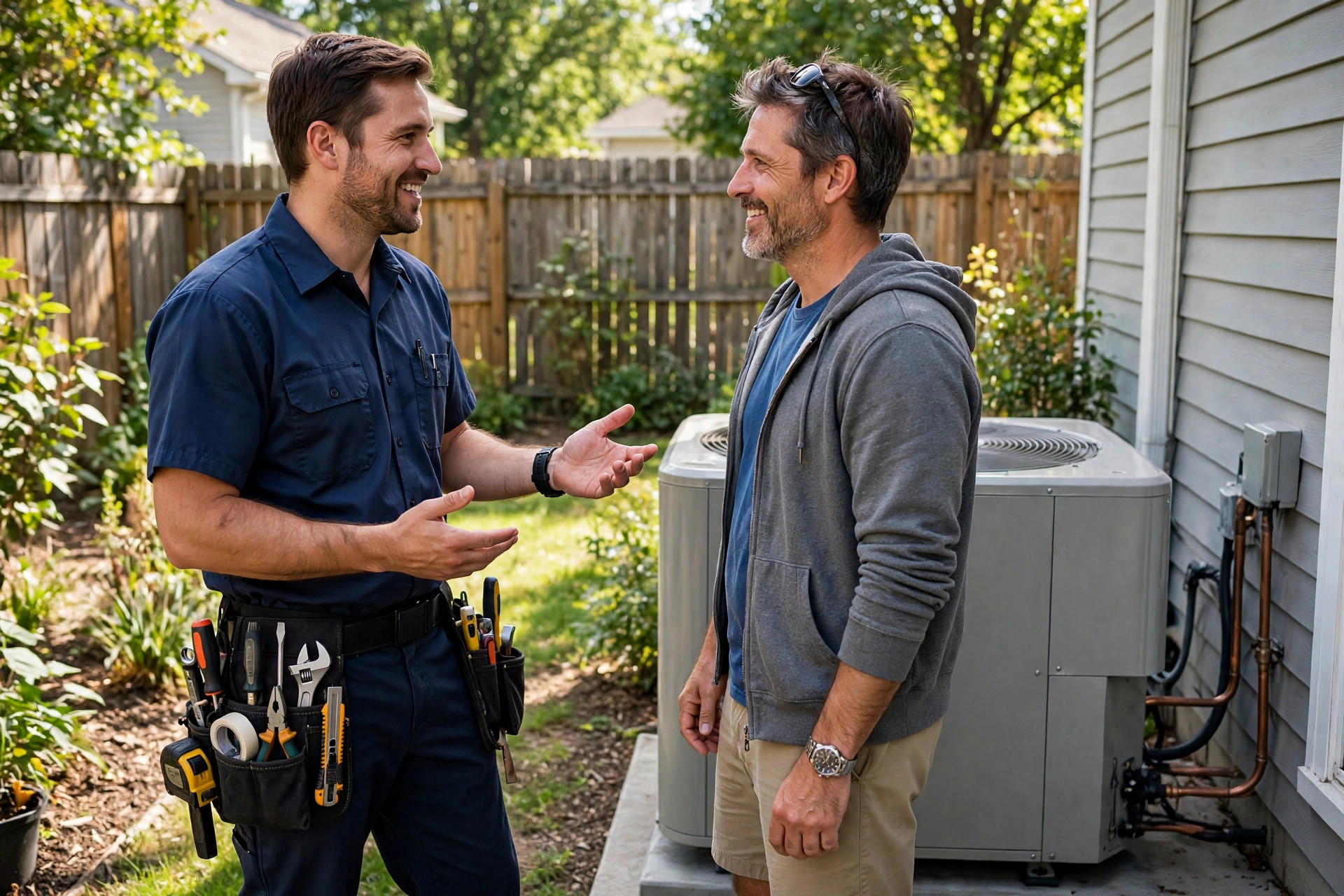
After the job is done and the system is running, the technician says something like: “Everything is running well. If you are happy with the work, would you mind leaving us a quick Google review? It really helps our local business. I can send you the link by text right now.” That is it. Short, warm, no pressure. As the HVAC marketing team at RS Gonzales puts it, this small step repeated consistently can double or triple a company’s monthly review count.
Make the ask frictionless. Put a QR code on every invoice and service summary that opens your Google review page directly. Hand the customer a small leave-behind card with the same code. Get the verbal yes before the technician leaves: “Can I send you the link by text tonight?” A customer who said yes is far more likely to follow through than one who got a cold text later. Socio AI’s HVAC review guide makes the same point: the in-person handoff makes the follow-up text feel expected instead of random, which lifts both open and conversion rates.

SMS review request templates for HVAC companies
Send the text within two hours of job completion, while the relief of a working system is fresh. One link, the customer’s first name, the technician’s name when you have it. Here are templates for the three job types.
Hi [First Name], this is [Tech Name] from [Company]. Your AC repair is all set. If you were happy with the work, a quick Google review would mean a lot: [link]
Hi [First Name], your new [system] installation is complete. We hope you are already feeling the difference. If you are happy with our work, a quick review helps other homeowners find us: [link]. Thank you, [Company]
Hi [First Name], thanks for the tune-up today. Your system is in great shape for the season ahead. Would you mind leaving us a quick Google review? It takes less than a minute: [link]
One reminder text the next day for non-responders, then stop:
Hi [First Name], just following up in case you meant to leave us a review after yesterday’s visit. Here is the link: [link]. Thanks either way, [Company]
Do not text customers who never agreed to receive messages, and never offer anything in exchange for a review. Ask every customer the same way, including the difficult ones. Selective asking, called review gating, violates Google’s policies.
Email review request templates for HVAC companies
Email is your backup channel, and it works best for bigger-ticket work: full system installs, commercial accounts, and customers who prefer written communication. Send it the day after the job if the text did not convert, with one clear link.
Subject: How was your install this week?
Hi [First Name], we hope you are enjoying the new [system]. As a local company, reviews are how new customers find us, and yours would mean a lot to our team.
If you have a minute, we would appreciate your honest feedback here: [Leave a Google Review]
Thank you for choosing [Company].
For seasonal tune-up customers on a maintenance plan, tie the ask to the relationship:
Subject: Thanks for trusting us with your tune-up
Hi [First Name], thanks for keeping up with your seasonal maintenance. If you have been happy with our service over the years, a quick Google review would help other homeowners in [City] find a contractor they can trust: [Leave a Google Review]
Seasonal tune-up follow-ups: turning maintenance visits into reviews
Tune-ups are your most reliable review source, and most companies waste them. A maintenance visit is low stress, the customer already trusts you, and you see them twice a year. That is two review opportunities per customer per year from your happiest segment.
Build the ask into the tune-up workflow. When the technician finishes the checklist, they mention one thing they checked or improved: “Your capacitor was starting to wear, so I replaced it before it failed on you this summer.” That specific, caring detail becomes the story the customer tells in the review. Then the standard ask and the automated text two hours later.
Use the shoulder seasons strategically. Spring and fall tune-up campaigns bring a wave of happy customers right before the peak seasons when emergency searches spike. A company that banks 40 tune-up reviews in April enters the summer rush with fresh, recent reviews dominating its listing, exactly when competitors are scrambling for emergency calls. Recent reviews matter: most consumers only trust reviews from the last few months, so timing your review pushes before peak season pays twice.
Catching unhappy customers before they review
The smartest review system does not just collect praise. It intercepts problems before they become public one-star reviews. The method: ask for private feedback first, then route.
Send a one-question satisfaction text shortly after the job: “On a scale of 1 to 10, how satisfied were you with today’s service?” Customers who answer 8 to 10 get the Google review link immediately. Customers who answer 7 or below get a different message: an apology, a direct phone number for the service manager, and a private feedback form. Their complaint lands in your office, not on your Google listing. Field service automation vendor Fieldproxy describes this exact routing as standard practice: the micro-survey acts as a sentiment filter, and rapid private follow-up often resolves the issue before it ever becomes a public review.
When a low score comes in, speed is everything. Call within the hour. Listen first, fix second, and document what happened. Common HVAC complaints have common fixes: a callback for a noise the tech missed, a clearer explanation of the invoice, a rescheduled appointment that ran late. Most customers who get a fast, genuine recovery never post the negative review, and some become more loyal than customers who never had a problem.
Responding to negative HVAC reviews
Some negative reviews will still slip through. Respond to every one within 48 hours. Future customers judge you by the response far more than by the complaint, and a professional reply to a harsh review can win you the next call.
The framework: acknowledge, take responsibility where appropriate, and move it offline. Never argue technical details in public or blame the customer.
Hi [Name], thank you for letting us know. We are sorry the experience did not meet your expectations. We would like to make this right. Please call [service manager name] directly at [phone] so we can resolve this today. [Your name], [Company]
For a review about pricing, which is the most common HVAC complaint:
Hi [Name], we understand your concern about the cost. We price our work to reflect licensed technicians, quality parts, and standing behind every job. We would welcome the chance to walk through your invoice line by line. Please reach us at [phone]. [Your name], [Company]
Respond to positive reviews too, briefly and by name. Mentioning the technician by name in your reply reinforces the team culture that earns the next review.
How reviews feed your map pack rankings
Reviews influence your Google Maps visibility through several distinct signals. Understanding each one tells you what to optimize.
| Review signal | What it means | How to improve it |
|---|---|---|
| Review count | Total number of Google reviews on your listing | Ask at every job site, automate the follow-up text |
| Average rating | Your star rating, shown next to your name in the map pack | Service recovery before public reviews, consistent quality |
| Review recency | How recently reviews were posted | Steady weekly flow, tune-up pushes before peak season |
| Review velocity | The pace of new reviews over time | A few per week beats a sudden burst, which can look unnatural |
| Review keywords | Words customers use: “AC repair”, “furnace install”, technician names | Detailed reviews come from specific, memorable service |
| Review responses | Whether and how you reply to reviews | Respond to every review within 48 hours |
| Review diversity | Presence across Google, Yelp, Facebook, industry sites | Google first, then add one or two more platforms |
An HVAC SEO analysis from Cited recommends targeting a steady three to five new reviews per week rather than chasing a one-time burst, and notes that more than half of consumers change their view of a company based on how its reviews are responded to. Velocity plus responses is the combination that moves both rankings and calls.
Review widgets on your HVAC website
Reviews should work on your website, not just on Google. Homeowners who click through from the map pack land on your site deciding whether to call. Reviews at that moment close the deal.
Put a Google reviews widget on your homepage showing your star rating and latest reviews. Add hand-picked reviews to service pages: furnace install reviews on the install page, AC repair reviews on the repair page. Create a dedicated reviews page with a “leave us a review” button for the customers you ask by email. If your site platform supports it, add review schema markup so star ratings can appear in organic search results too.
Choose reviews that mention specifics: the technician’s name, the problem solved, the speed of the emergency response. “Mike got our AC running at 9pm on a Saturday” sells better than “great service” because it answers the fear of the next homeowner reading it.
Your monthly HVAC review checklist
- 1Confirm technicians are asking at every job site and the two-hour follow-up text is sending.
- 2Check that every satisfaction score of 7 or below got a manager callback within the hour.
- 3Respond to every new review, positive and negative, within 48 hours.
- 4Log total review count, new reviews this month, and average rating in one tracker.
- 5Compare your count, rating, and recency against two or three local competitors.
- 6Refresh the reviews shown on your homepage and top service pages.
- 7Review complaint patterns with your lead techs and fix the top recurring issue.

FAQs about Google reviews for HVAC
How many Google reviews does an HVAC company need?
Enough to lead your local market. In most metro areas the top-ranked HVAC companies have several hundred reviews with new ones arriving weekly. More important than the total is the flow: a steady few per week with recent dates beats a large count of old reviews.
Should my technicians really ask for reviews in person?
Yes. The technician at the job site is your highest-converting review channel, because the trust and timing are unmatched. Train a short script, provide QR codes on invoices, and track which techs generate the most reviews. Recognition for top performers keeps the habit alive.
What if a customer leaves an unfair negative review?
Respond professionally with the acknowledge and invite-offline framework. Do not argue the technical details in public. If the review violates Google’s policies, flag it, but focus on the response: future customers reading a calm, solution-oriented reply often trust you more, not less.
Can I offer a discount for leaving a review?
No. Google prohibits incentives for reviews, and the FTC requires disclosure of any compensated endorsement. Ask for honest feedback with no strings attached. You can reward technicians for review volume, but never reward the customer for writing one.
Do reviews really affect my Google Maps ranking?
Yes. Google’s own guidance lists review count and score as local ranking factors, and review signals carry meaningful weight in map pack analyses. Beyond rankings, reviews decide the click: the higher-rated company with more recent reviews wins the emergency call even from a lower map position.
Want a review system your techs will actually use?
We help HVAC companies build review generation into their website and follow-up, from automated texts to review widgets that turn finished jobs into your best marketing. The same ask-every-customer system works across local services; see our guide to getting more Google reviews for the same method in another industry.
Contact Us