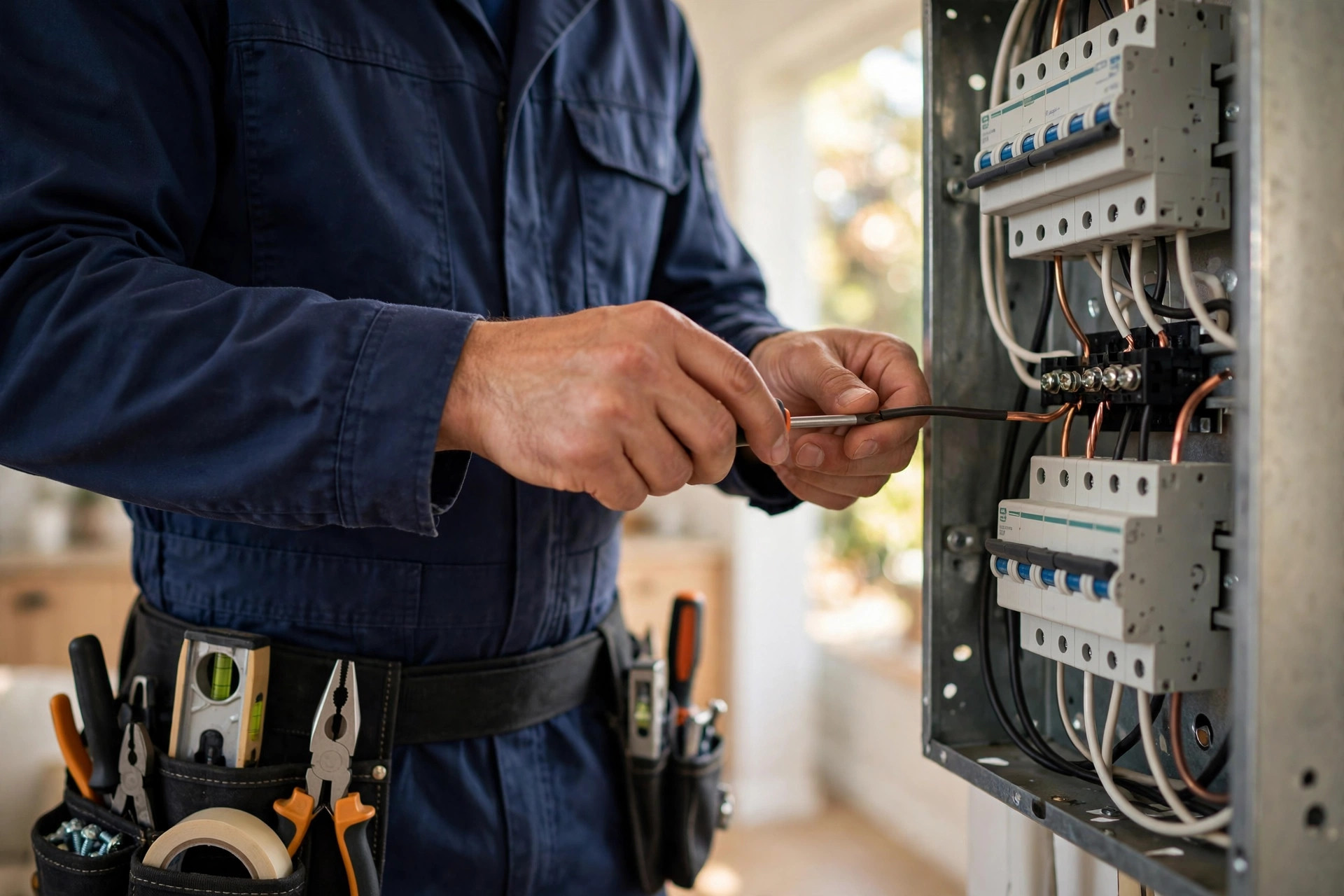
A homeowner with a dead panel at 9pm searches for an electrician on their phone. Google shows three businesses with three review profiles: one with 340 reviews, one with 96, one with 14. The homeowner will probably never visit any of the three websites. They will tap the listing that looks most trusted, which almost always means the one with the most reviews, the freshest reviews, and a rating the owner clearly takes seriously. That tap is worth hundreds or thousands of dollars, and it is decided by work you did long before the search. This guide shows electrical businesses how to build a review system that runs on every job: the verbal ask at payment, the job-completion card with a QR code, the post-job text the next day, and how to answer every review in a way that wins the next customer.
The quick answer
- Why it matters: reviews are one of the strongest trust signals in local search, and nearly 9 in 10 local consumers read them before choosing a service business.
- The three moments that produce reviews: a verbal ask while taking payment, a completion card with a QR code left at the job, and a short text message the next day.
- The benchmark to aim for: at least 100 Google reviews, a 4.5 star rating or better, and 2 to 5 new reviews every week.
- Small shops beat big contractors by asking in person at the moment of highest satisfaction, while large companies rely on software and often feel impersonal.
- Respond to every review within 24 hours, including the five star ones. Your responses are read by future customers, not just the reviewer.
- Never pay for, fake, or filter reviews. Google removes them, accounts get suspended, and one exposed scheme costs more trust than a hundred honest reviews ever build.
Why reviews decide which electrician gets the call
Electrical work is high trust and high ticket. A customer who needs a panel upgrade or a full rewire is handing you the keys to their home and several thousand dollars. They cannot judge your workmanship from a search result, so they judge it from what other people say about you. Studies of local consumer behavior keep returning the same pattern: most people read reviews before contacting a local business, and Google is the platform where most of that reading happens. When your business shows up in the local map results, your review profile is your ad. The big contractor with 300 reviews does not just rank better. It looks safer, and safer wins the tap.
Reviews also feed the ranking itself. Google’s local ranking considers how prominent a business looks, and review count, average rating, recency, and how often new reviews arrive all play into that. A shop with 14 reviews from two summers ago can sit below a competitor with 200 recent ones even when both are the same distance from the searcher. For more on how your profile ranks, see our guide to Google Business Profile optimization for contractors.
What customers actually read in your profile
It is not only the star number. Searchers scan four things in about ten seconds. First, the total count. A business with 180 reviews feels established; one with 12 feels like a gamble. Second, the recency. Reviews from last week tell a searcher you are active and doing good work right now. Reviews that stop eight months ago raise the question of whether you are still in business. Third, the words inside the reviews. Customers look for mentions of the job they need: panel upgrade, EV charger install, troubleshooting a short, rewiring an old house. A review that says “replaced our panel and cleaned up everything” sells the next panel job better than any ad copy you write. Fourth, your responses. When the owner answers reviews, the business reads as alive and accountable. When nobody answers, it reads as absent.
The honest benchmark for an electrical business
Targets keep your team honest. As working benchmarks, aim for at least 100 Google reviews before you consider your profile strong, a 4.5 star average or higher, at least 2 to 5 new reviews landing every week, and a 100 percent response rate with replies going out within one business day. The exact number that puts you ahead depends on your competitors, so check the top three listings for your main services and your city, then set your target above the strongest one. If the biggest shop in town has 240 reviews, your goal is 300, not 100.
The three moments that produce reviews
Most review guides hand you a list of twenty tactics. You only need three moments, executed on every job. Reviews are a timing game. People write them when they feel grateful and when it is easy. Your job is to be present at those moments and remove every bit of friction. Everything else in this guide is support for these three moments.
Moment one: the verbal ask while taking payment
The highest point of satisfaction in an electrical job is the moment the work is finished, tested, and explained, and the customer is paying. The lights work, the panel is clean, the technician was professional. That is when the review should be asked for, in person, by the person who did the work. The script is short: “We are a small local shop and reviews are how new customers find us. If you were happy with the work, a Google review would mean a lot. I can text you the link.” Two things matter in that script. It explains why the review matters, which gives the customer a reason beyond politeness, and it promises the link, which removes the objection of “I do not know how.”
Train every tech to say it on every completed job, not just the ones where the customer seems thrilled. The techs who are shy about asking are usually imagining rejection. The reality is that satisfied customers are glad to be asked; they simply never think of it on their own. Role-play the ask in a team meeting until it sounds natural. Tie it to the payment step so it becomes a habit: collect payment, explain the work, ask for the review, leave the card. The same personal touch that wins residential work applies across the trades; our guide on getting more Google reviews for HVAC companies shows the same three-moment pattern working in a similar trade.
Moment two: the job-completion card with a QR code
Some customers will not write the review while you are standing there, and some jobs end when the customer is not home. The completion card catches them all. It is a small, sturdy card, business-card size or a little larger, left on the counter or handed over with the invoice. It has three things: a thank you, one sentence explaining that reviews help a local shop compete, and a QR code that opens your Google review page directly. No instructions to search for your business, no “find us on Google,” no multi-step process. One scan, and the phone opens the review screen with your business already selected.
Keep the card clean and physical. It should feel like a small thank you, not a coupon flyer. Print a few hundred at a time so the cost is pennies per job, and keep a stack in every van. The QR code must point to your direct review link, which Google generates in your business profile settings. Test the scan yourself on both an iPhone and an Android phone before printing, because a code that opens a broken page is worse than no card. Many shops also add a tiny handwritten note on the card, like the tech’s first name, which lifts the response rate because it feels personal.
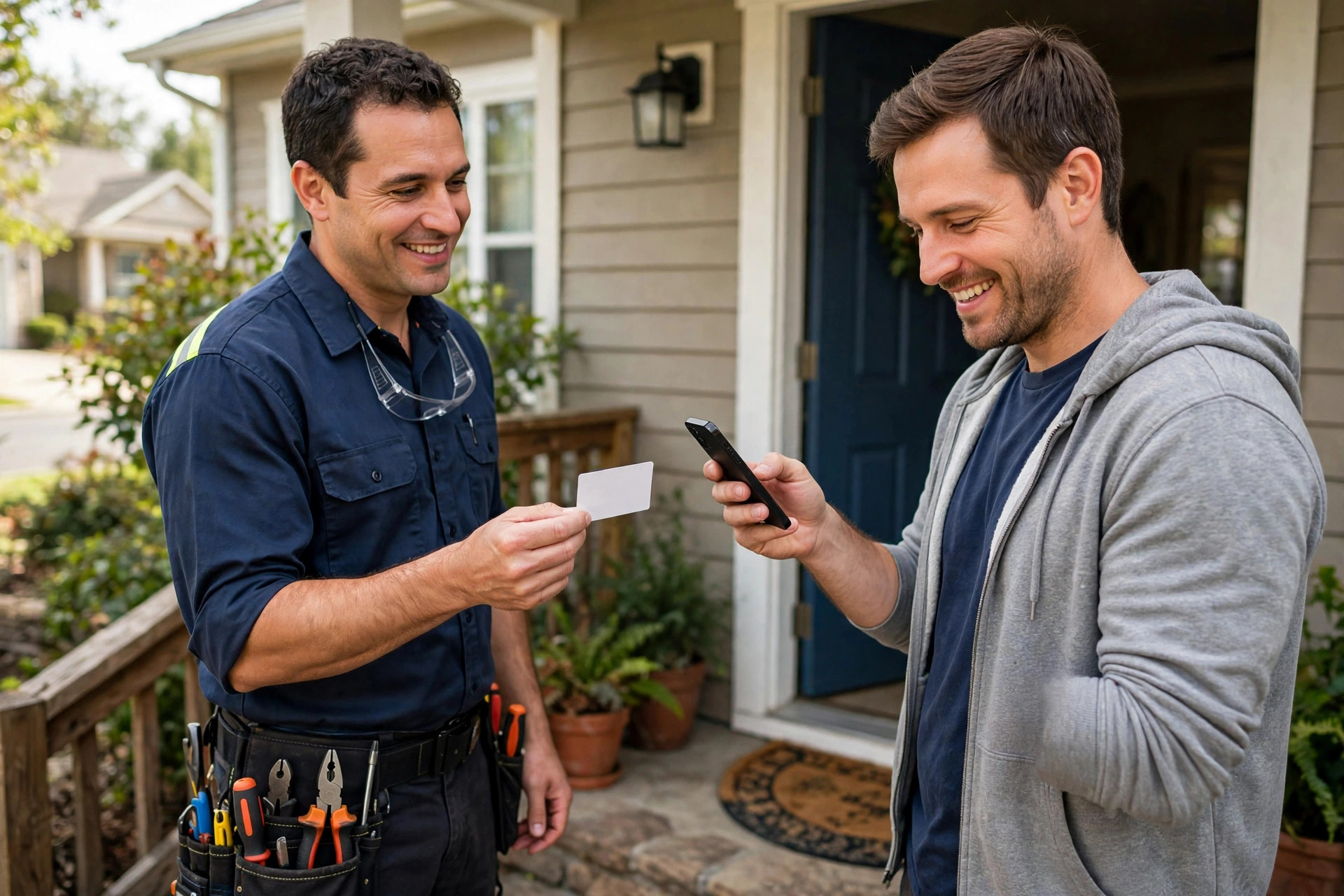
One scan opens the review screen directly. Every extra step is a review you never get.
Moment three: the post-job text the next day
The morning after the job, send a short text. It thanks them, checks that everything is still working, and includes the review link. This message catches the customers who meant to leave a review and forgot, and it catches the ones who were not home at the finish. Send it from the business number, between 9am and noon, and keep it to three short lines: “Hi, this is [Name] from [Shop]. Just checking the panel work is still running well. If everything looks good, a quick Google review would really help our small shop: [link].” That is it. No coupon, no survey, no second link.
The follow-up rule matters as much as the message. Send one reminder three to five days later if there is no review, and then stop. A second nudge is a reminder. A third is pestering, and it is the customers who were about to leave a good review who get annoyed by the fourth text. Automate this if your booking or invoicing software supports text follow-ups, which many field service platforms now do. If you do everything manually, batch the texts into a daily habit: every morning, text yesterday’s customers. The habit takes five minutes and produces reviews for years.
Building the system so it runs without you
The three moments only work if they happen on every job, and they only happen on every job if they are someone’s job. The most common failure in review marketing is the owner being the whole system: it works for three weeks, the owner gets busy, and review flow stops for four months. Build the system around roles, not around you.
Assign the ask to a role, not a mood
Write the review process into the job close-out the same way you wrote the safety checklist. The technician owns the verbal ask and leaves the card. The office or dispatcher owns the next-day text and the one reminder. Put both steps on the job ticket so they are visible, not assumed. If you use a checklist app, add “review ask done” as a line item next to “site cleaned” and “payment collected.” When a new tech joins, the review script is part of their first-week training, right after the van tour and the safety briefing.
One direct review link everywhere
Every card, text, email signature, and website button should open the same direct review link. Google provides this in your business profile under the option to share your review form. Shorten it with your own domain if you can, or a clean short link, so it looks trustworthy in texts. A link that says yourshop.com/review gets clicked more than a 90-character string of random letters. Test it monthly. Businesses change their profile name, Google changes the link format, and a dead review link silently kills your review flow for months before anyone notices.
Track review velocity like revenue
You track jobs booked and revenue collected. Track reviews the same way. Once a week, note three numbers: total review count, average rating, and how many new reviews arrived that week. Put it on the same sheet or screen as your other weekly numbers. When velocity drops, you know the ask is not happening, and you can fix it the same week instead of discovering a two-month gap. A shop that treats review count as a weekly metric outpaces one that treats it as a marketing project, because metrics get attention and projects get postponed.
Competing with contractors ten times your size
The big shops have advantages: marketing budgets, review software, staff dedicated to follow-up. But they have a weakness, and it is the same weakness that makes customers nervous about them: they feel corporate. Your shop has the one thing review systems cannot buy, which is a real person standing in the customer’s home, asking honestly for help growing the business. Lean into it.
| What big contractors do | What a small electrical shop should do | Why the small shop wins this round |
|---|---|---|
| Automated email blasts to every customer | Verbal ask from the tech at payment | A personal ask converts far better than a mass email |
| Paid review platforms with branded pages | A printed card with a QR code, tech’s name handwritten | Physical and personal beats polished and generic |
| Sheer volume: hundreds of reviews | Recency: fresh reviews every single week | Customers trust “last week” more than “last year” |
| Generic “great service” reviews | Job-specific reviews mentioning panels, EV chargers, rewires | Specific reviews sell the next identical job |
| Corporate responses or silence | The owner replies by name within a day | Owner replies signal accountability no brand can copy |
| Ads for “best electrician near me” | A review profile that wins the tap for free | The profile is permanent; the ad stops when the budget does |
Win on recency and detail, not just totals
You will not out-count a 40-truck contractor this year. You can out-fresh them. A searcher comparing your profile to theirs reads the dates, and a stream of reviews from the last few weeks says you are the shop doing the work right now. Every review that names the job type also helps twice: once as trust, once as keyword-rich content that matches what the next customer is searching for. When a customer says “ask for the review and mention the job,” make it easy by reminding them: “If you mention the panel upgrade, it helps other people with the same problem find us.” Specificity is free and it compounds.
Put your reviews where customers decide
Do not leave reviews trapped on Google. Pull your best ones onto your website: a review section on the homepage, job-type reviews on the service pages, and a few quotes in your estimate emails. When the same five-star words appear on Google, on your site, and in the proposal, the customer starts to believe them. That repetition is exactly how the big contractors present themselves. You can match it without their budget.
Your van in the driveway is advertising. Your review profile should finish the job it starts.
How to respond to every review
Responding is not optional. Future customers read your responses almost as closely as the reviews themselves, and Google has said owner responses are part of a healthy profile. The goal of a response is not to convince the reviewer. It is to show the next hundred readers what kind of business you run. Keep responses short, name the job when you know it, and never copy and paste the identical reply twenty times. Readers notice.
The five-star response
Thank them by name, reference the work, and invite them back. “Thanks, Sarah. Glad the panel upgrade and the new circuits are running well. Call us any time if you need anything.” Three sentences. The job reference proves the review is real and tells the next searcher you do that work. The invitation keeps the door open for the next job. Vary the wording so your profile does not read like a robot wrote it.
The four-star response
Thank them and address the missing star lightly. “Thanks for the review, Mike. We are glad the EV charger install went well. If anything about the visit could have been better, I would like to hear it so we can fix it.” Most four-star reviews have a small complaint hiding in them, scheduling, a delay, a mess. Acknowledging it shows you read the review, and sometimes the reviewer updates the rating after you respond.
The bad review playbook
Bad reviews happen to every electrical business. The response is a fixed process, not an improvisation. Reply within 24 hours. Acknowledge the problem without arguing or assigning blame. Move it offline with a direct phone number: “I am sorry about this, Tom. This is not how we work. I am the owner, call me directly at [number] and I will make it right.” Then call them, fix what you can, and update your response once it is resolved. Never discuss prices, never name the tech publicly, and never respond angry. A calm owner response to a harsh review impresses readers more than twenty five-star reviews. Our detailed playbook on how to respond to negative Google reviews walks through the harder cases, including unfair and fake reviews.
What can get you in trouble
A few rules are absolute, and breaking them can erase everything this guide builds. Never offer payment, discounts, or freebies in exchange for reviews. Never ask only the happy customers and skip the unhappy ones, a practice called review gating, which Google prohibits. Never write reviews for your own business, and never ask staff or family to do it. These look like shortcuts, and Google’s systems and your competitors both watch for them. Reviews get removed, profiles get suspended, and the Federal Trade Commission has fined businesses for fake and paid review schemes. The honest system in this guide is slower for about three weeks and faster forever after.
Your 30-day implementation checklist
Do this in order. By day 30 you will have a review system that runs without you thinking about it.
- 1Get your direct review link. Open your Google Business Profile, generate the shareable review link, shorten it with your domain or a clean short link, and test it on two phones.
- 2Design and print the completion card. Thank you line, one sentence about helping a local shop, and a big QR code pointing at the review link. Print enough for a month of jobs and put stacks in every van.
- 3Write the verbal ask script. Keep it to three sentences. Practice it in a team meeting until every tech can say it without reading it.
- 4Write the next-day text. Three lines: thanks, check the work is fine, review link. Save it as a template in your phone or dispatch software.
- 5Add the steps to the job ticket. “Verbal ask done, card left” for the tech; “next-day text sent” for the office. If it is on the ticket, it happens.
- 6Set your review targets. Check the top three competitors, set your count target above the strongest one, and aim for 2 to 5 new reviews per week.
- 7Respond to every existing review. Clear the backlog first, starting with the most recent. This shows Google and searchers that the profile is active.
- 8Start the weekly metric. Every week, log total reviews, average rating, and new reviews that week. When the number stalls, the ask stopped happening, and you fix it that week.

Payment is the moment of peak satisfaction. The verbal ask and the card turn it into a review.
Frequently asked questions
How many Google reviews does my electrical business need?
Aim for at least 100 before you consider your profile strong, then set your target above your strongest local competitor. What matters as much as the total is recency: 2 to 5 new reviews per week keeps your profile looking active and helps it rank in the local map results.
Is it okay to offer a discount for a Google review?
No. Paying for reviews, including discounts and freebies in exchange for them, violates Google’s policies and can get reviews removed or your profile suspended. Review gating, asking only happy customers, is also against the rules. Ask every customer the same way.
How should I respond to a bad review from an electrical customer?
Reply within 24 hours, acknowledge the problem without arguing, and move the conversation offline with your direct phone number. Fix what you can, then update your response. Never discuss prices or name employees publicly. See our full guide to responding to negative Google reviews for the harder cases.
What is the best time to ask for a review?
Right after the job is finished, tested, and explained, while taking payment. That is the moment of highest satisfaction. Follow up with a completion card left at the job and a short text the next morning for customers you missed or who forgot.
Do QR code review cards actually work for electricians?
Yes, when the QR code opens your direct Google review page with one scan. The card works because it removes every step between the customer’s good feeling and the review screen. Handwrite the tech’s name on the card for a personal touch that lifts response rates.
Turn every finished job into your next customer
Digital Hayder helps electrical businesses build review systems, local marketing, and AI follow-up that run on autopilot: review request texts, missed-call text back, and a website that converts the traffic your reviews bring. Tell us where your shop is and we will map the fastest path to more five-star reviews.
Contact Us