Montessori vs Daycare: Which Is Better for Your Child in 2026?
Choosing between Montessori and daycare is one of the most important decisions you'll make for your child's early development. With so many options available, it's easy to feel overwhelmed. But recent research has shed new light on how these approaches compare, making it easier for parents and childcare professionals to make informed choices.
In 2026, a groundbreaking $3 million, three-year randomized study revealed that children in public Montessori programs showed significant improvements in reading ability and short-term memory compared to their peers in traditional daycare settings [4]. These findings have reignited the conversation about which approach truly benefits children most during their formative years.
Understanding the Core Differences
Montessori and daycare might both serve children, but they operate on fundamentally different principles. Montessori education follows a child-centered approach developed by Dr. Maria Montessori over a century ago. It emphasizes independence, freedom within limits, and respect for a child's natural psychological development.
Daycare, on the other hand, typically focuses on providing supervision and care while parents are at work. Traditional daycare centers often follow a more structured schedule with group activities and teacher-directed learning. The primary goal is often childcare rather than education, though quality daycares do incorporate educational elements.
The Educational Philosophy
Montessori classrooms are designed to foster self-directed learning. Children choose their activities from a carefully prepared environment that encourages exploration and discovery. The teacher works as a guide rather than an instructor, allowing children to learn at their own pace.
In contrast, daycare programs typically follow a teacher-led curriculum with activities scheduled for the entire group. While quality daycares do provide educational opportunities, the approach tends to be more structured and less individualized than Montessori.
Learning Environment
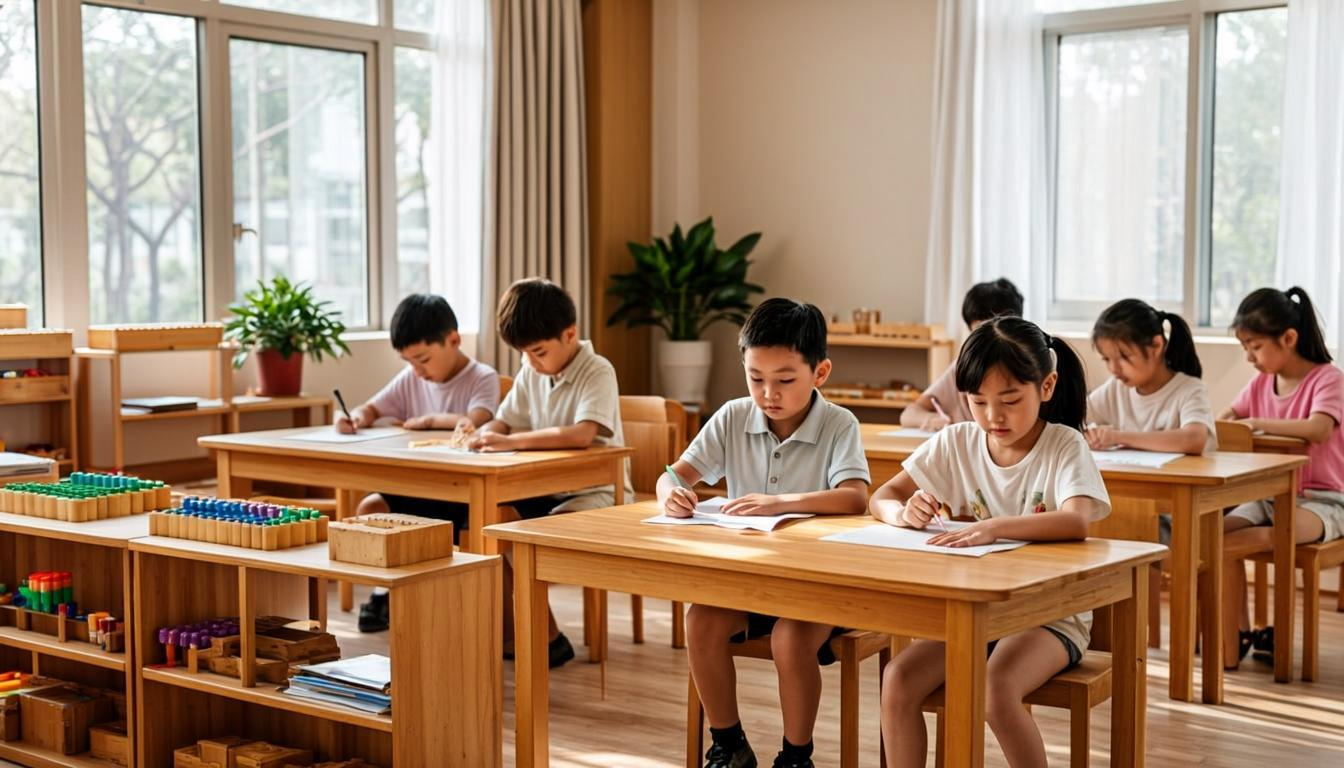
Montessori environments are meticulously prepared with child-sized furniture and materials that promote independence. The classrooms are typically arranged in subject areas (practical life, sensorial, math, language, etc.) and encourage movement and choice.
Daycare environments often prioritize safety and supervision. While they do have educational materials, the setup is generally more focused on group activities and may not offer the same level of specialized learning equipment found in Montessori classrooms.
Academic Performance Comparison
Recent research has provided compelling evidence about the academic benefits of Montessori education. A national randomized controlled trial conducted in 2025 found that children who attended public Montessori preschool demonstrated significantly better reading abilities than those in traditional programs [1].
The same study revealed that three years of public Montessori from ages 3 to 6 cost districts $13,127 less per child than traditional preschool programs [1]. This finding challenges the perception that high-quality education necessarily comes with a higher price tag.
Long-term Educational Outcomes
Children in Montessori programs tend to develop stronger executive function skills,the cognitive processes that help us plan, focus attention, and manage multiple tasks. These skills are strong predictors of long-term academic success and life achievement.
Research from the University of Virginia shows that Montessori students not only excel academically but also develop stronger social and emotional skills. They demonstrate greater creativity, better problem-solving abilities, and more advanced social cognition than their peers in traditional settings [2].
Short-term Memory Development
One of the most striking findings from recent studies is the impact of Montessori education on short-term memory. The $3 million randomized study mentioned earlier found that children who attended public Montessori programs showed significant improvements in short-term memory compared to those in traditional daycare settings [4].
This cognitive advantage appears to stem from Montessori's emphasis on self-directed learning and hands-on materials that require children to focus, remember sequences, and complete multi-step tasks independently.
Cost Considerations for Families
When comparing Montessori and daycare, cost is often a major factor for families. While Montessori education was traditionally associated with high tuition costs, recent developments have changed this landscape.
Public Montessori programs now offer an accessible alternative to private options. The 2025 study found that public Montessori programs cost districts significantly less per child than traditional preschool while delivering better outcomes [1]. For families, this means they may have access to high-quality Montessori education through public school systems at a lower cost than they might expect.
Tuition Comparison
Private Montessori schools typically charge premium tuition that can range from $8,000 to $15,000 per year for preschool programs. This is often higher than traditional daycare costs, which generally range from $5,000 to $12,000 annually depending on location and services provided.
However, the value proposition of Montessori education becomes clearer when considering the long-term benefits. The improved academic performance, stronger executive function skills, and better social development demonstrated by Montessori students may offset the initial investment for many families [2].
Financial Assistance Options
Many public Montessori programs offer tuition assistance or operate on a sliding scale fee structure based on family income. Additionally, some states offer childcare subsidies that can be applied to Montessori programs, making them more accessible to diverse socioeconomic groups.
For families considering private Montessori, many schools offer payment plans or scholarships. Some employers also offer childcare benefits that can be applied to Montessori tuition, reducing out-of-pocket costs for working parents.
Social Development Differences
Beyond academic performance, the social development of children in Montessori versus daycare settings shows interesting differences. Both environments offer opportunities for social interaction, but the quality and nature of these interactions vary significantly.
Montessori classrooms typically feature mixed-age groups, where children learn from peers both older and younger than themselves. This structure promotes natural social development, as older children model behaviors for younger ones, and younger children benefit from the guidance of older peers.
Conflict Resolution Skills
Research indicates that Montessori students develop stronger conflict resolution skills than their peers in traditional daycare settings. The Montessori method explicitly teaches children to respect others' work, wait their turn, and resolve conflicts peacefully through guided practice and role-playing.
In contrast, daycare environments with larger group sizes and more structured activities may provide fewer opportunities for children to develop these skills organically. Teachers in traditional daycare settings often intervene more directly in conflicts, which can limit children's ability to learn negotiation and compromise skills.
Independence and Self-Regulation
Montessori environments foster remarkable independence in young children. By allowing children to choose their activities and work at their own pace, Montessori students develop strong self-regulation skills and internal motivation.
Daycare programs, with their more structured schedules and teacher-directed activities, tend to develop different strengths. Children in daycare often excel at following group routines and adapting to changing schedules,skills that are valuable in traditional school environments.
Making the Right Choice for Your Child
Deciding between Montessori and daycare isn't about which approach is "better" universally,it's about which approach best meets your child's unique needs and your family's values and circumstances.
Consider your child's learning style and personality. Does your child thrive with structure and guidance, or do they work better when given freedom to explore? Does your child have specific learning needs or challenges that might be better addressed by one approach over the other?
Practical Considerations
Logistical factors also matters in your decision. Consider location, hours of operation, and transportation needs. Montessori programs may have different schedules than traditional daycare centers, which could impact your family's daily routine.
Staff qualifications differ between Montessori and daycare settings. Montessori teachers require specialized training and certification in the Montessori method, while daycare staff typically need early childhood education credentials but may not have the same specialized training.
Visiting Programs
The best way to understand the difference between Montessori and daycare is to visit programs in person. Observe how teachers interact with children, how children engage with their environment, and the overall atmosphere of the space.
During visits, pay attention to classroom dynamics. Are children engaged and focused? Do they seem happy and comfortable? How do teachers respond to children's questions and needs? These observations can provide valuable insights that go beyond what you'll find on websites or in brochures.
Key Takeaways
-
Recent research shows that Montessori education delivers better reading abilities and short-term memory development compared to traditional daycare [1], [4].
-
Public Montessori programs cost districts $13,127 less per child than traditional preschool while providing superior outcomes [1].
-
Montessori environments foster independence, self-directed learning, and mixed-age social interaction that develop strong executive function skills [2].
-
Daycare programs typically offer more structured, teacher-led activities with emphasis on group routines and adaptation to scheduled changes.
-
The choice between Montessori and daycare depends on your child's individual learning style, personality, and your family's values and logistical needs.
-
Visiting potential programs in person is crucial for understanding which environment will best support your child's development.
The Bottom Line
As you consider Montessori versus daycare for your child, remember that both approaches can provide valuable experiences and care. However, recent research increasingly supports the benefits of Montessori education for developing strong academic foundations, executive function skills, and social competence.
The decision ultimately comes down to what will work best for your child's unique needs and your family's circumstances. By understanding the differences between these approaches and considering the latest research, you'll be better equipped to make an informed choice that supports your child's development and sets them up for success in school and beyond.
Ready to explore Montessori options in your area? Schedule visits to local programs and observe how they support children's natural curiosity and development. Your child's educational journey begins with the choices you make today.